
Showing posts with label pencil. Show all posts
Showing posts with label pencil. Show all posts
Monday, January 9, 2017


Thursday, December 29, 2016
Basilica di Santa Ciara, Assisi

A view, drawn from life in my sketchbook, of the basilica of Saint Clare - the close companion of Saint Francis of Assisi. She is buried there, in the 19th century crypt.
But the building is 13th century, and is a nice enough example of the rather squat Italian Gothic style of the central Middle Ages. It's basically a huge stone barn, with what are surely the ostriches of the flying buttress world. They barely look as if they could get off the ground at all.
Saturday, July 30, 2016

Tuesday, July 26, 2016

Thursday, March 10, 2016
Near Sisteron

A few years ago I spent a few weeks cycling in Provence. A few day's ride up the Durance you may find the absurdly dramatic town of Sisteron, and adjacent (just across the river, in fact) to it this small burg. Beyond it, the beginnings of the Cottian Alps.
Thursday, March 3, 2016
life is good
Sitting on the bench with a good book (it may have been The Marriage of Cadmus and Harmony), under the window on a sunny day. Not a bad thing at all. I didn't have time to draw the window or sun, though.
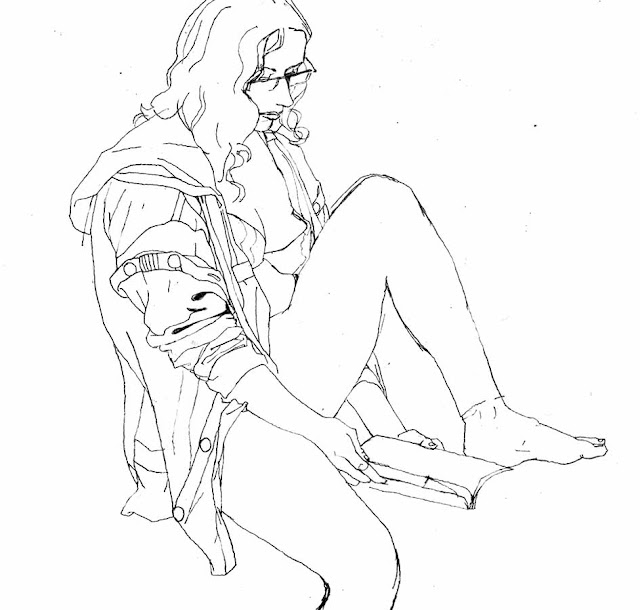
Drawn from life with a pencil, in around 30 minutes.

Drawn from life with a pencil, in around 30 minutes.
Thursday, January 14, 2016
tree and Saint Peter's
I drew this in a matter of minutes, standing in the window of the Vatican Pinocoteca. There was a Raphael near by, but sometimes real life outweighs the greatest masterpieces.
You can see the arch and stairway reading to the garden pavilion begun by Pope Paul IV in 1558, now known as the Casina Pio IV after the later pope who competed it. In the distance, the huge dome of Saint Peter's, and between them a beautiful pine tree that deserves a name of its own - to judge by its size, it may be as old as the buildings.

You can see the arch and stairway reading to the garden pavilion begun by Pope Paul IV in 1558, now known as the Casina Pio IV after the later pope who competed it. In the distance, the huge dome of Saint Peter's, and between them a beautiful pine tree that deserves a name of its own - to judge by its size, it may be as old as the buildings.

Tuesday, January 5, 2016
rest your voice

A pencil sketch of Tarragon, pausing between songs. As much as I love to draw clothes, I hate musical instruments - their shapes obey a logic of their own that denies them easy compatibility with the people who carry them. In pictures at least, because in pictures depicted objects have a much closer and more causal relationship to each other than real objects do in space.
Thursday, May 14, 2015
The towers of Siena
One April I cycled to Siena, the rose-red gothic metropolis of central Tuscany that, of all the many beautiful medieval cities in Italy, is perhaps the most beautiful.
I arrived from Florence. In that city, apparently, they have a traditional proverb about Siena:
Siena
Di tre cose e piena:
Torri, campane,
E figge di putane.
I shall leave it untranslated. Let it be a warning to anyone here who’s thinking of visiting this most charming of Italian cities. It should also be a warning about Florence. For a city that for 500 years has prided itself on speaking the purest Italian (except Siena, see below), and producing the best poets (or at least Dante, who counts as more than one), you’d think they’d be able to come up with something better.
Or maybe the point is to express maximum contempt with the least possible effort. I lived in Toronto for a long time, and it makes me wonder: are there poets in Hamilton or Windsor right now, sharpening their pens?

Back to Siena. Norman Douglas summed it up in one word: "hell." I can only say that of all cities I’ve visited, except Venice, it is the most beautiful. Now if only we could get rid of the Senese, who profit from the immigrant labour of southern italy, but refuse to speak to the labourers. Or so I was told by an indignant Sicilian I met on Via Fiorentina.
In Siena they speak, tourist books claim, the most pure and refined Italian to be found in the country, but I’m sceptical. Someplace or another has to have a title like this one, but why is it always a town full of money and visibly smug in its affluence? But this is just predjudice on my part. My command of the language is not sufficient to enable me to judge for myself. All I can say is that in Siena Italian is much easier to understand than in the Veneto, and that here all the women enunciate every letter in ciao, stretching the word out so that it rhymes with meow, like a cat. It’s an enchanting habit.
I arrived from Florence. In that city, apparently, they have a traditional proverb about Siena:
Siena
Di tre cose e piena:
Torri, campane,
E figge di putane.
I shall leave it untranslated. Let it be a warning to anyone here who’s thinking of visiting this most charming of Italian cities. It should also be a warning about Florence. For a city that for 500 years has prided itself on speaking the purest Italian (except Siena, see below), and producing the best poets (or at least Dante, who counts as more than one), you’d think they’d be able to come up with something better.
Or maybe the point is to express maximum contempt with the least possible effort. I lived in Toronto for a long time, and it makes me wonder: are there poets in Hamilton or Windsor right now, sharpening their pens?
Back to Siena. Norman Douglas summed it up in one word: "hell." I can only say that of all cities I’ve visited, except Venice, it is the most beautiful. Now if only we could get rid of the Senese, who profit from the immigrant labour of southern italy, but refuse to speak to the labourers. Or so I was told by an indignant Sicilian I met on Via Fiorentina.
In Siena they speak, tourist books claim, the most pure and refined Italian to be found in the country, but I’m sceptical. Someplace or another has to have a title like this one, but why is it always a town full of money and visibly smug in its affluence? But this is just predjudice on my part. My command of the language is not sufficient to enable me to judge for myself. All I can say is that in Siena Italian is much easier to understand than in the Veneto, and that here all the women enunciate every letter in ciao, stretching the word out so that it rhymes with meow, like a cat. It’s an enchanting habit.
Wednesday, May 6, 2015
The basilica at Assisi
One fine spring day I bicycled to Assisi (from Perugia - it wasn't much of a journey) with my sketchbook and sat down to draw buildings.
So here is a fast sketch of the famous basilica of San Francesco. It's a great building, if you're into gothic architecture. It's two churches, one of them built atop the other - you can see the entrance to the lower one at the bottom of the steps on the left. Whether Saint Francis himself would have been pleased with it is another question.

Even if you're not into architecture, the frescos by Giotto make the trip worthwhile, and Assisi itself is a very charming town. Here is a sketch of the town square, complete with Roman ruins, that I did on the same trip.
So here is a fast sketch of the famous basilica of San Francesco. It's a great building, if you're into gothic architecture. It's two churches, one of them built atop the other - you can see the entrance to the lower one at the bottom of the steps on the left. Whether Saint Francis himself would have been pleased with it is another question.
Even if you're not into architecture, the frescos by Giotto make the trip worthwhile, and Assisi itself is a very charming town. Here is a sketch of the town square, complete with Roman ruins, that I did on the same trip.
Tuesday, January 27, 2015
jeans and a sweater
%2Bdd.jpg)
An old drawing, done on toned paper from life. It probably took about 40 minutes, although something obviously went wrong with one of the hands.
Tuesday, December 2, 2014
Vicino Montalcino
A few years ago I used to take bicycle trips in Italy. It kept me fit, and there was always something to draw.
On one day in mid-April, I set out from Siena and cycled south into the countryside. Monte Amiata loomed over me like a Tuscan Mount Fuji all day long. About mid-day, just before climbing the hill to Montalcino (where I would find a Brunello to fit in my bicycle's bottle-holder), I passed some farmhouses.
There wasn't time for more than a quick sketch:

On one day in mid-April, I set out from Siena and cycled south into the countryside. Monte Amiata loomed over me like a Tuscan Mount Fuji all day long. About mid-day, just before climbing the hill to Montalcino (where I would find a Brunello to fit in my bicycle's bottle-holder), I passed some farmhouses.
There wasn't time for more than a quick sketch:
Thursday, July 17, 2014
3 academics...
...listening intently to a lecture on the early stages of the invention of the astrolabe.

Sunday, February 16, 2014
Basilica Servi di Maria, Siena
A very swift sketch of the view from the via S.Salvadore in Siena, Tuscany, looking towards the basilica of the Servite order. There wasn't much time, but I was able to block in the geometric essentials of the view.

Tuesday, December 10, 2013
The gothic church of St.Pierre in Avignon

It's the clocktower of the church of St.Pierre, in Avignon. I was there a few years back; I cycled along the south coast of France and around Provence, carrying a tent and my sketchbook. Avignon was among the most attractive - although not the most welcoming - of the cities I visited. Its chief merit, other than unreasonable quantities of medieval architecture, was delicious kebab and a very pleasant campsite.
There's really nothing like rolling out of your tent in the morning and seeing the Palace of the Popes across the river.
St.Pierre is not attached to the Palace of the Popes, but is more or less contemporary. It shares - except for the 16th c. facade - the same aggressive Provencal Gothic style of architecture. It's all sharp angles, spikes, and small beady windows. Not very friendly.
+dd.jpg)
It is fun to draw, however.
Wednesday, October 16, 2013
Ponte Santa Trinita
A quick pencil sketch of the ponte Santa Trinita in Florence. My pencil didn't quite capture the elegance of Ammanati's design - the bridge is one of those objects whose lines are simply entrancing.
I drew it from the northern embankment, sitting up on the stone barrier.
+dd.jpg)
I drew it from the northern embankment, sitting up on the stone barrier.
+dd.jpg)
Tuesday, April 16, 2013

Wednesday, February 13, 2013
Naples
A quick pencil sketch of a piazza in Naples, at once the most grimy and most tantalizing of cities I have visited. I did this standing, in less than 5 minutes - there were places to be!

Amidst the chaos of Italian cities the orchards of television antennae strike a particularly charming note. It will be a sad day for landscape artists when they are all replaced by satellite dishes.

Amidst the chaos of Italian cities the orchards of television antennae strike a particularly charming note. It will be a sad day for landscape artists when they are all replaced by satellite dishes.
Monday, November 12, 2012
The Pleasure of Ruins
One of the most interesting phenomenons in the history of architecture is the reuse and transformation of ancient ruins. For us, ruins are often attractive. People go out of their way to enjoy the suggestive aura of dilapidated castles and abandoned factories.
Our generally positive attitude towards ruins is a consequence of living in a rich society. In the past, people were more likely to dismantle a ruin for spare building material, like the Iraqi villagers who burnt a great Assyrian bull to render it into quicklime.
Religious buildings are a special case. For early Christians, Roman temples were an abode of demons. One way to deal with them was to build a church on top of the temple, as in the case of the basilica of San Clemente in Rome, built above an ancient mithraeum. Another approach was simply to consecrate the pagan building to a new patron: in this way the Pantheon (also in Rome) became the church of Holy Mary of the Martyrs.
After the end of the ancient religion, pagan temples no longer posed a threat. By the time of the Renaissance, "past ruin'd Latium" became an object of fascination to artists and scholars.
But the era before the Renaissance remains a mystery. In the 10th century, when Rome was a half-abandoned ghost town fought over by dimly chronicled warlords, a group of Greek monks settled down to live in the ruins of the temple of Mars Ultor ("The Avenger"). Why did they choose that spot? Did the God of War mean something to them, or was it just a convenient pile of stones?
Perhaps the ruins spoke to the monks. In the 5th century, Sidonius Apollinaris wrote of seeing "cattle not only lying in the half-ruined porticoes, but grazing beside altars green with weeds," language which suggests he took some pleasure in the view, even as he deplored it. And Paul the Deacon, in the 8th century, wrote "the dwellings were left deserted by their inhabitants, and the dogs alone kept house... You might see the world brought back to its ancient silence; no voice in the field, no whistling shepherds..." Grim stuff, but beautiful words. Around the same time, an anonymous Anglo-saxon writer penned The Ruin, a meditation that begins:
The wallstone is beautiful
but broken by fate.
The city is shattered
the old work of giants is falling...
Obviously some people were enjoying the sight of the ruins, even if they didn't go to the 18th century extreme of building fake ones. We still did this in the 20th century, of course, for example at the Guildwood in Toronto.
All this is leading up to a picture of my own, of course:

Our generally positive attitude towards ruins is a consequence of living in a rich society. In the past, people were more likely to dismantle a ruin for spare building material, like the Iraqi villagers who burnt a great Assyrian bull to render it into quicklime.

Religious buildings are a special case. For early Christians, Roman temples were an abode of demons. One way to deal with them was to build a church on top of the temple, as in the case of the basilica of San Clemente in Rome, built above an ancient mithraeum. Another approach was simply to consecrate the pagan building to a new patron: in this way the Pantheon (also in Rome) became the church of Holy Mary of the Martyrs.

After the end of the ancient religion, pagan temples no longer posed a threat. By the time of the Renaissance, "past ruin'd Latium" became an object of fascination to artists and scholars.
But the era before the Renaissance remains a mystery. In the 10th century, when Rome was a half-abandoned ghost town fought over by dimly chronicled warlords, a group of Greek monks settled down to live in the ruins of the temple of Mars Ultor ("The Avenger"). Why did they choose that spot? Did the God of War mean something to them, or was it just a convenient pile of stones?
Perhaps the ruins spoke to the monks. In the 5th century, Sidonius Apollinaris wrote of seeing "cattle not only lying in the half-ruined porticoes, but grazing beside altars green with weeds," language which suggests he took some pleasure in the view, even as he deplored it. And Paul the Deacon, in the 8th century, wrote "the dwellings were left deserted by their inhabitants, and the dogs alone kept house... You might see the world brought back to its ancient silence; no voice in the field, no whistling shepherds..." Grim stuff, but beautiful words. Around the same time, an anonymous Anglo-saxon writer penned The Ruin, a meditation that begins:
The wallstone is beautiful
but broken by fate.
The city is shattered
the old work of giants is falling...
Obviously some people were enjoying the sight of the ruins, even if they didn't go to the 18th century extreme of building fake ones. We still did this in the 20th century, of course, for example at the Guildwood in Toronto.


All this is leading up to a picture of my own, of course:

This is the ruin at Chateau-Bas, in Provence. No one knows to what god the temple was dedicated. What we do know is that at some point, probably in the 11th century, somebody built a small Christian chapel adjoining the ruins of the temple, from which the stones were taken. The temple is now a wreck, but its columns still stand, and it must have been even more impressive when the chapel was built. Today the chapel is dedicated to Saint Cézaire, presumably Caesarius of Arles. We have no way of knowing whether this was the case originally, or who built it, or why they chose the spot they did.
The drawing was done in pencil, in the early afternoon, during a bicycle ride from Cadenet to Salon-de-Provence. It was a pleasant idyll, sadly interrupted by an eruption of kindergarten children. As the teacher said to me as they approached, "Your peaceful solitude, it is over."
Tuesday, August 14, 2012
Appropriation and desire
Danielle went to Egypt and all she got was this galabiya:


The intricacies of fashion are a never-source of delight for me. I could happily draw different outfits all day long. It helps, too, that fashion is such a responsibility-free business. An individual can own a design, but a culture has no property beyond that which people concede to it. And as a general rule, fashion never concedes anything.
This has its downsides. Had the t-shirt remained a culturally specific garment, people all around the world would be dressed better. Or at least more interestingly. As it is, half the outfits in Athens, Georgia, are as boring as in Athens, Greece. Luckily, the other half provides more than enough subjects for me to draw.
Subscribe to:
Posts (Atom)